Nowość wydawnicza
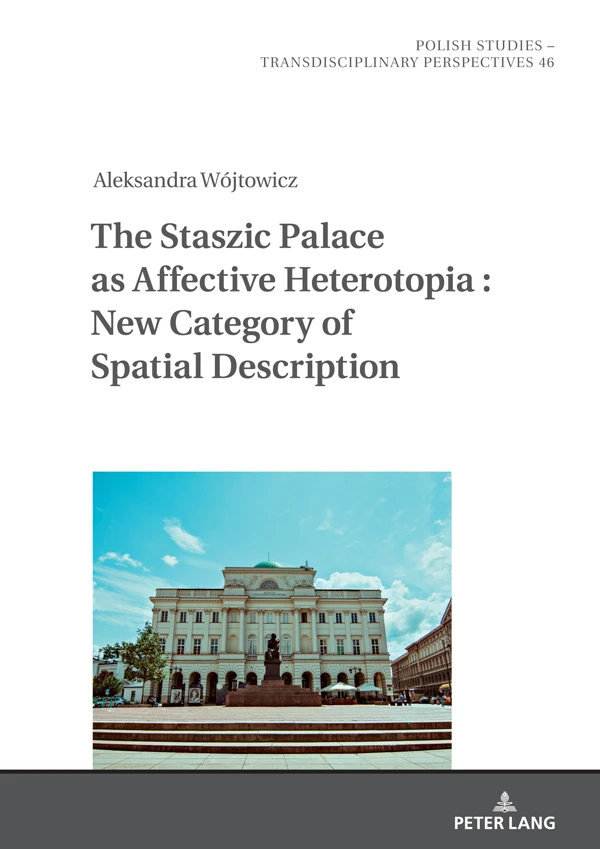
The Staszic Palace as Affective Heterotopia: New Category of Spatial Description
W Peter Lang International Academic Publishers ukazała się książka dr Aleksandry Wójtowicz o Pałacu Staszica jako heterotopii afektywnej.
Tłumaczenie: Lindsay Davidson
Link: https://www.peterlang.com/document/1484167
Link do wydania polskiego (Wyd. IBL PAN 2017) w RCIN: https://rcin.org.pl/dlibra/publication/196572/edition/162556?language=en
Projekt został zrealizowany w ramach Narodowego Programu Rozwoju Humanistyki "Uniwersalia".
Spis treści
Cover
Title
Copyright
About the author
About the book
This eBook can be cited
Table of Contents
The History of the Staszic Palace in the Historical Context of Warsaw and Poland: Commentary on the English Edition by Krzysztof Mordyński
PART I Behind the Palace
The Passer-by who sees this monument… – archaeological layers
The Fight for the traces of victory
The place where it all began – historical layers
Between the church and the Moscow Chapel
PART II House of Polish Science, the Building Interior
Interior architecture, collections, institutions
The orthodox church in the building – returns to earlier meanings
About the (lottery) fate of the Staszic Palace
About the independent fate of the Staszic Palace
PART III Between the Meeting Room and the Temple of Victory
Thinking about the nation’s past and future
Not just the Legions’ military activity, not just the Society’s scientific role
When the sciences are useful
The heir’s voice, or the Staszic Palace as seen by Wacław Berent
PART IV In Front of the Palace
The external facade and its reconstruction
Further layers of the facade and 3D events on the palace building
The building’s place on the city plan – Plac Akademiczny
The unveiling of the monument – about intellectual battle
PART V Affective Heterotopia: About Methodology
The matter of definition: genesis and reception
Foucault’s concept and features of the palace
The affective dimension, towards new trends
Epilogue: Between Plac Akademiczny and Plac Zwycięstwa
Interview for Biuletyn Polonistyczny (2019): The case of the Staszic Palace, or about history and place
Bibliographic Note
Selected Bibliography
List of Illustrations
About the Author
Index of Names
Series index
Informacje
Zobacz także
Reassessing Communism. Concepts, Culture, and Society in Poland, 1944-1989
Autor/Redaktor: Katarzyna Chmielewska, Agnieszka Mrozik, Grzegorz Aleksander Wołowiec
Trzynastu badaczy podjęło się krytyki dominującej narracji o komunizmie w Polsce, proponując nowe analizy tego pojęcia, a także badając przejawy antykomunizmu. Publikacja jest wynikiem prac w ramach grantu NPRH (2013-2020) pod kierownictwem prof. Michała Głowińskiego. Grant był realizowany w Ośrodku Studiów Kulturowych i Literackich nad Komunizmem IBL PAN.
Gender, Generations, and Communism in Central and Eastern Europe and Beyond
Autor/Redaktor: Anna Artwińska, Agnieszka Mrozik
Communism in twentieth-century Europe is predominantly narrated as a totalitarian movement and/or regime. This book aims to go beyond this narrative and provide an alternative framework to describe the communist past. This reframing is possible thanks to the concepts of generation and gender, which are used in the book as analytical categories in an intersectional overlap.
From the House of the Slave to the Home of the Brave. The Motif of Home in Poetry by Black Women since the late 1960s
Autor/Redaktor: Jerzy Kamionowski
Kategoria: Filologie obce Autorzy: Jerzy Kamionowski Rok wydania: 2019 Numer ISBN: 978-83-7431-592-0 Liczba stron: 169 Format: B5, oprawa twarda Wydawncitwo Uniwersytetu w Białymstoku
Grzegorz Moroz,A Generic History of Travel Writing in Anglophone and Polish Literature.Series:Textxet: Studies in Comparative Literature, Volume: 93
Autor/Redaktor:
A Generic History of Travel Writing in Anglophone and Polish Literature offers a comprehensive, comparative and generic analysis of developments of travel writing in Anglophone and Polish literature from the Late Medieval Period to the twenty-first century. These developments are depicted in a wider context of travel narratives written in other European languages. Grzegorz Moroz convincingly argues that, for all the similarities and cross-cultural influences, in the course of the nineteenth and twentieth century non-fiction Anglophone and Polish travel writing have dynamically evolved different generic horizons of expectations. While the Anglophone travel book developed relatively steadily in that period, the Polish genre of the podróż was first replaced by the listy (kartki) z podróży, and then by the reportaż podróżniczy.