Polish Studies Newsletter

Event

Date of the event: 21.02.2026 g.15:00 - 21.02.2026 g.17:00
Added on: 17.02.2026

Jakub Barua: Polish roots, Kenyan camera – from Łódź to Nairobi

Type of the event:
Inne
City or town:
London
Target groups:
Others

The Research Center on the Legacy of  Polish Migration of the Polish Writers Abroad Charity (London) (OBeDeP) and Blue Point Art London warmly invite you to an online event in virtual London – a space for conversation where film becomes a map of memory, and biography a story of living “in between” cultures. We’ll be joined by Jakub Barua – a director, screenwriter and film producer born in Łódź (1967), who has lived and worked in Nairobi for many years. He is recognised as one of the pioneers of modern Kenyan cinema and a leading voice in an authorial, “poetic” approach to documentary film. In his work, history and lived experience of place intertwine with myth and symbolism, while his striking, almost painterly visual style guides viewers through themes of migration, identity and memory. In the second part of the event, Prof Aleksandra Łukaszewicz will present the project “Hybrid BIO_GEO-GRAPHIES of Jakub Barua” (Virtual Film Memorial) – an immersive format bringing together film, memory and technology (including VR), creating a virtual archive and a poetic map of belonging in a Poland–Africa dialogue.
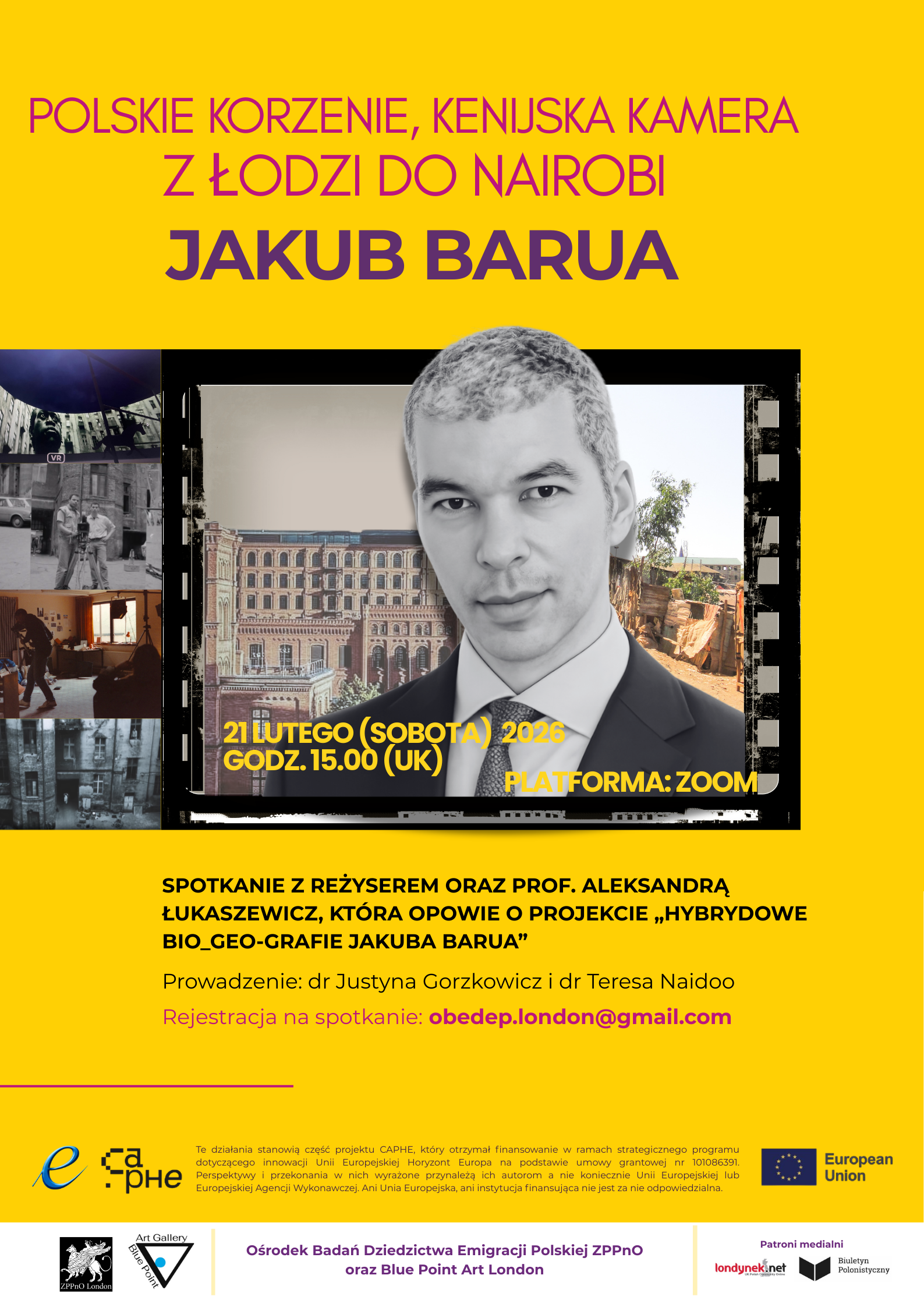
During our event, we would like to explore how, in Jakub Barua’s work – a director, screenwriter and film producer born in Łódź (1967) and based in Nairobi for many years – the image behaves like memory: it returns, shifts, and brings the tangible (history, biography, everyday life) into dialogue with myth and symbolism. Barua is regarded as one of the pioneers of modern Kenyan cinema and a leading voice in an authorial, “poetic” approach to documentary film. He is also a highly regarded photographer in Kenya – his work is held in private collections in Denmark, the UK, the USA and Italy, and his photographs regularly appear at international art auctions. In his films, storytelling often takes the form of dreamlike maps of memory. With great sensitivity, Barua weaves history and biography together with myths and symbols that shape his multicultural identity. This is held together by a distinctive, almost painterly visual language – at times slightly surreal, yet always rooted in the lived experience of place. An important early chapter of his practice was his collaboration with his brother, cinematographer Stan Barua, which helped define and develop the films’ recognisable visual style.

In the first part of the meeting, we will discuss key themes in Barua’s filmography and how his cinema guides viewers through spaces and memories – from Łódź to the Kenyan coast. We will look at how he combines lived realities (migration, war, life at cultural crossroads) with a poetic, symbolic narrative layer. Recurring motifs include Icarus as a figure of risk and transgression, ritual as a gesture of initiation and farewell, and subtle references to Conrad (Heart of Darkness). Landscape is also central – the city, the courtyard, the ocean shoreline – shown as a space of memory, legend (including flood myths) and everyday human experience. We will refer to selected films including: This–That (1989), Welcome (1990), In My Memory (1990), Forgotten Places (1994), Polish Shades (1999), My Daddy Was a Uhlan (2006).

The second part of the event will be dedicated to the project/exhibition “Hybrid BIO_GEO-GRAPHIES of Jakub Barua” (Virtual Film Memorial), developed within the CAPHE project. Prof Aleksandra Łukaszewicz will present the idea of an immersive format bringing together film, memory and technology (including VR), creating a “virtual archive” and a poetic map of belonging in a Poland–Africa dialogue. The meeting will conclude with an open Q&A – we warmly welcome your questions and comments.

Hosted by: Dr Justyna Gorzkowicz (OBeDeP) & Dr Teresa Naidoo (PUNO)
Registration: Please email obedep.london@gmail.com (we will reply with the Zoom link).

These activities form part of the CAPHE project, funded by the European Union’s Horizon Europe programme for research and innovation under Grant Agreement No. 101086391. The views and opinions expressed are those of the authors only and do not necessarily reflect those of the European Union or the European Research Executive Agency. Neither the European Union nor the granting authority can be held responsible for them.


Information

Added on:
17 February 2026; 00:25 (Justyna Gorzkowicz)
Edited on:
17 February 2026; 00:30 (Justyna Gorzkowicz)

See also

30.05.2016

Vladimir Nabokov and the Fictions of Memory

Almost 40 years after Nabokov's death his texts continue to function as literary Fabergé eggs in which scholars keep finding hidden surprises and previously overlooked details. As Nabokov wrote in Conclusive Evidence, "the unravelling of a riddle is the purest and most basic act of the human mind." However, readers and critics are divided on the issue of whether Nabokov is a postmodern riddle-maker enjoying the game itself without enabling the player to reach the ultimate solution, or whether the riddles are solvable by a reader astute enough to follow all the sophisticated patterns and allusions which point to Nabokov's metaphysical convictions.

29.04.2025

Transformations of Shoah Trauma in Post-2000 Literatures

In the eighty years since the end of the Second World War, perspectives on the Shoah have evolved significantly, shaped by geopolitical and social factors. ese shifts have encompassed periods of silence, an inability or unwillingness to process the catastrophe´s exceptional scale, and movements toward visibility, fascination, marginalization, denial, privatization, instrumentalization and commercialization. As historical distance grows, new generations of writers, artists, and scholars face the challenge of representing this trauma in ways that engage contemporary audiences while remaining anchored in historical memory.

18.07.2017

THE 1ST BIAŁYSTOK CONFERENCE ON THEORETICAL AND APPLIED LINGUISTICS

In recent years linguistic conferences organized by the Białystok circle of neophilologists have established a strong tradition in terms of providing a forum for the exchange of views on the nature of language. It all started almost fifteen years ago, in 2002. The main aim of the conferences was to provide a meeting ground for a wide range of scholars: linguists, literary scholars, foreign language teaching methodologists, to mention but a few groups of researchers participating in the events. The conferences explored the relationship between language, culture, and social interaction. They were often organized in co-operation with French language scholars.

03.03.2017

Traumatic Modernities: From Comparative Literature to Medical Humanities / International Conference and Seminars

Organizers:

We use cookie files to make the use of our website more convenient for our users. If you do not wish cookie files to be saved on your hard drive, please change the settings of your browser. Read about our cookie policy.