Artykuł / wywiad
#ScienceForUkraine
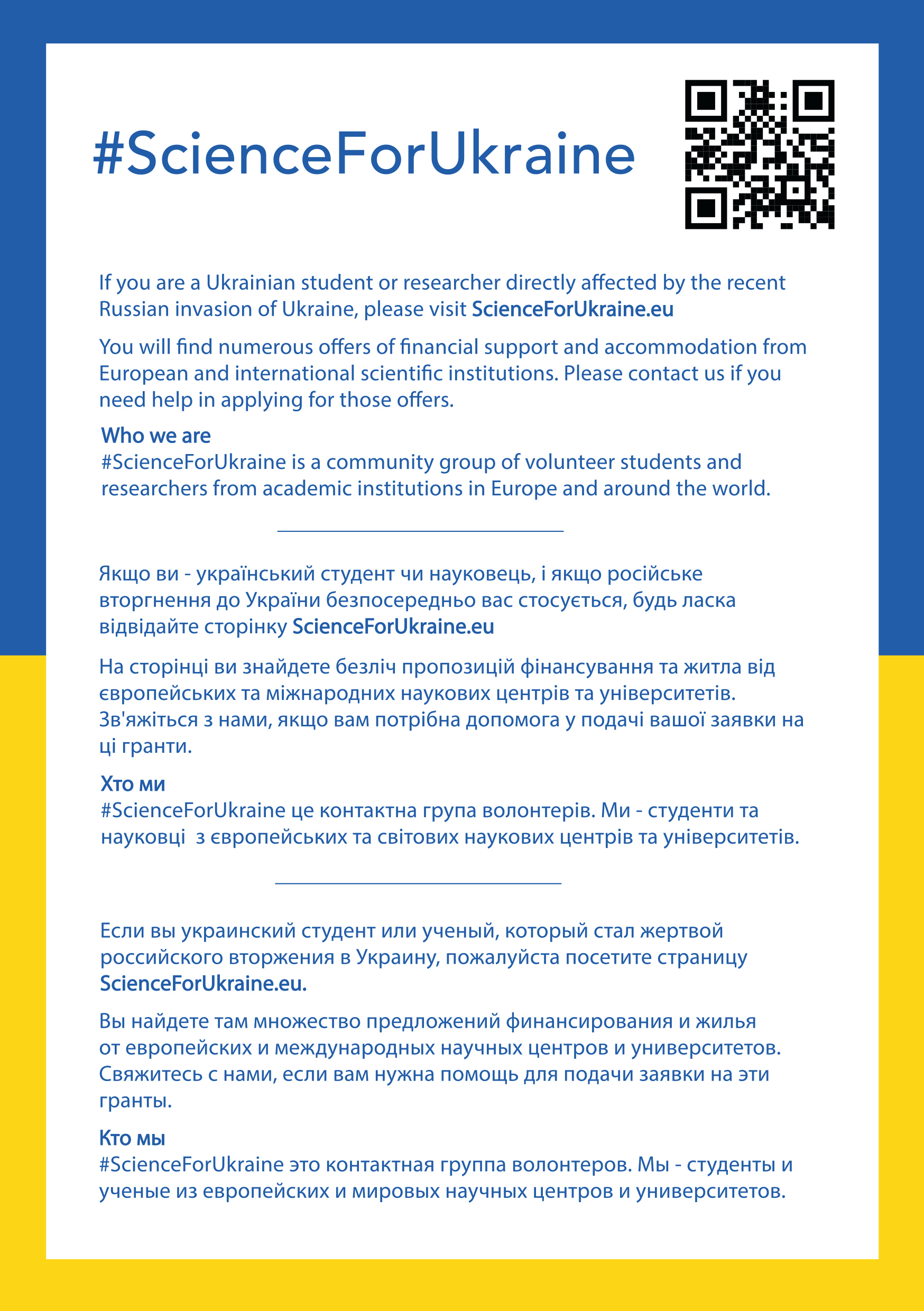
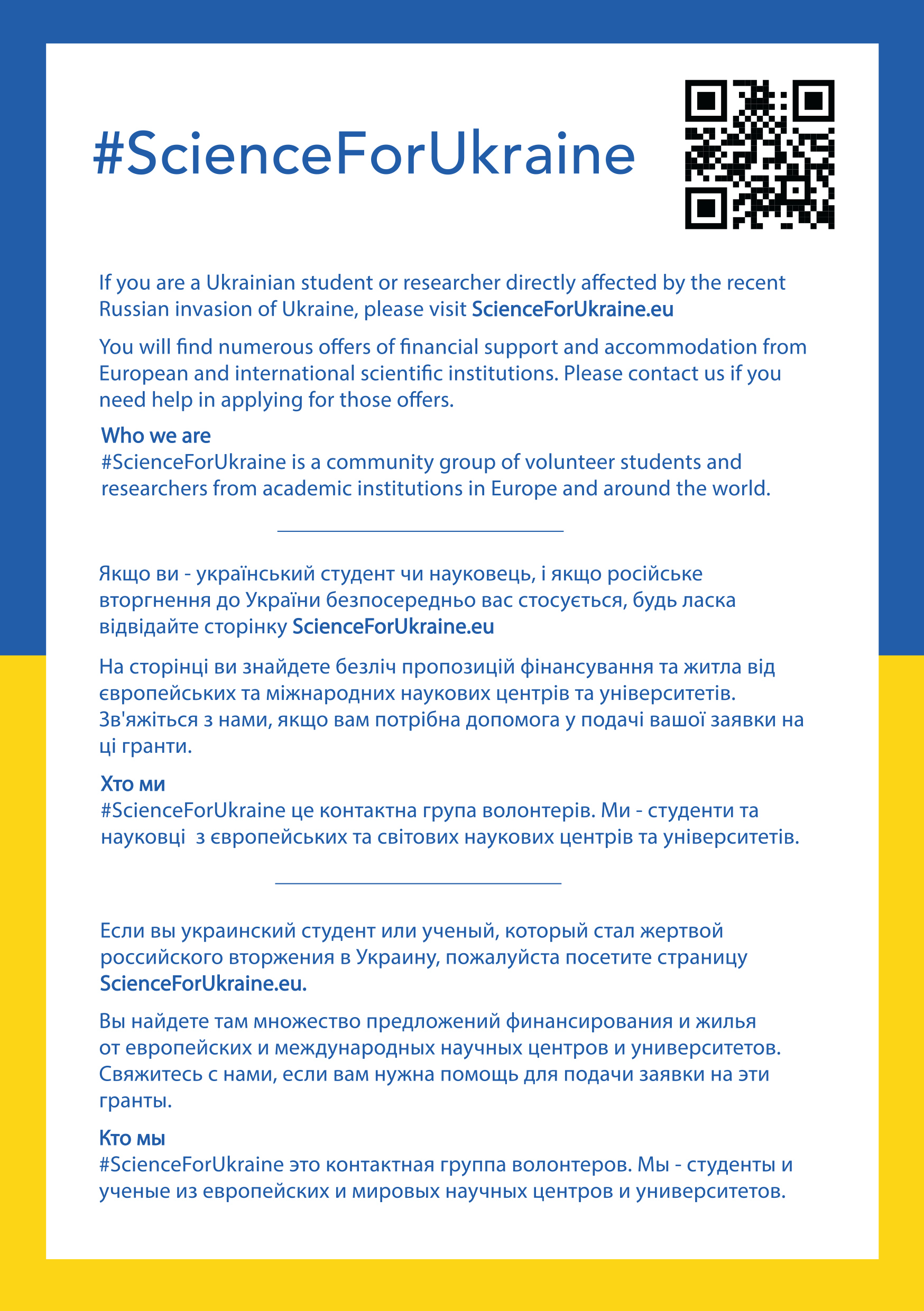
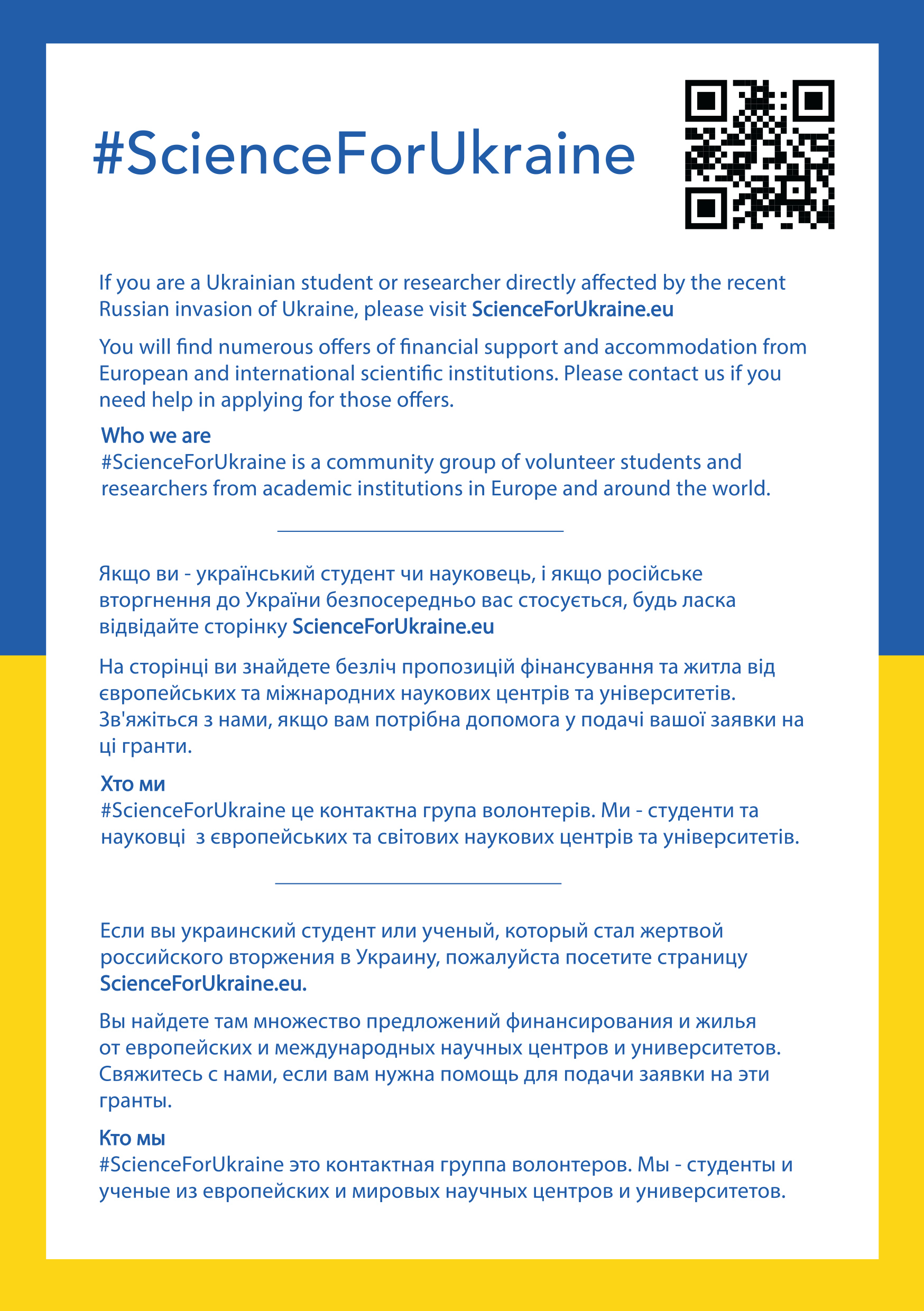
#ScienceForUkraine is a community group of volunteer students and research scientists from academic institutions in Europe and around the world. Its mission is to collect and disseminate information about support opportunities at the university, national, and international level for students and researchers directly affected by the recent Russian invasion of Ukraine.
Given the uncertain situation the support should be provided for the longest possible period, but not shorter than 3 months. Even such short offers (i.e., in form of visits) could provide immediate help and allow scholars time and means to apply for more stable positions or grants. Accommodation and office/lab space should be included.
We recommend that organisations collect information on support in a coordinated way. If your institution does not have a coordinator, perhaps you can act as one to collect the offers and submit them to us in a coherent way?
If you submit offers to us, please use this template (Excel). Just duplicate the file to your Google Drive or download the file.
Forward the file to your national coordinator or Sanita Reinsone.
Post the information about the support on your website! Provide as many details as possible including email and other contact details, so where people in need can get in touch.
Contact your country's #ScienceForUkraine coordinator if you would like to submit information about available support or need advice about #ScienceForUkraine.
#ScienceForUkraine is coordinated by Sanita Reinsone and her team at University of Latvia's Institute of Literature, Folklore and Art of the University of Latvia (ILFA): Elīna Gailīte, Justīne Jaudzema, Ilze Ļaksa-Timinska, Antra Upeniece
She is supported by Maciej Maryl (outreach coordination/press relations) and Michael Rose (internal coordination/onbording)
Informacje
Zobacz także
Israeli Universities' Emergency Fellowships for Ukrainians
Below is a list of Israeli Universities/institutions of higher learning that offer emergency fellowships for scholars/students from Ukraine. The list will get updated as more universities and departments join in every day. There are also several individual scholars or labs that are willing to offer fellowships. I will update the list when I get more info from them. You can also contact me directly and i will do my best to help you navigate the system: innale@openu.ac.il.
OPERAS business models survey on open access books
https://jisc.onlinesurveys.ac.uk/operas-business-models-survey-on-open-access-books
Art in the Places of Death. An interview with Prof. Halina Taborska
"Halina Taborska's book (...) is a peculiar study of the aesthetics of an anti-humanistic act. In fact it introduces such "aesthetics" to the readers, and we are presented with a very carefully prepared documentation of various objects, material and spatial shapes, "installations", murals, museum organizations and documentary activities. These are various shapes in the public space which mediate our perception of an unimaginable crime or "blinding” shapes that protect us from the damages of seeing it again. By bringing this collection of practices together, the book shows their character and multiplicity. The research material gathered in the publication and the scholarly approach make it a must-read not only in the study of war crimes in Europe, but also in the study of symbolic representation of mass crimes - especially in the field of cultural studies, cultural anthropology and art history.” (Prof. Jan Stanisław Wojciechowski, Academy of Fine Arts in Warsaw - excerpt from the review on the cover).
Competition for scholarships for researchers from Ukraine
The competition is an expression of solidarity with the Ukrainian academic community and is intended to support the best researchers from Ukraine. The main goal of the competition is to enable researchers to come to the University of Lodz to conduct research, which will consequently contribute to strengthening the scientific potential and development of our University.