Wydarzenie
The Reception of British Women Writers in 19th-Century Poland: The Case of Elizabeth Gaskell
The Research Center on the Legacy of Polish Migration (ZPPnO – Union of Polish Writers Abroad in London) warmly invites you to an online lecture by Pola Biblis, to be held on 6 March 2026 at 6:00 pm (London time) on the Zoom platform.
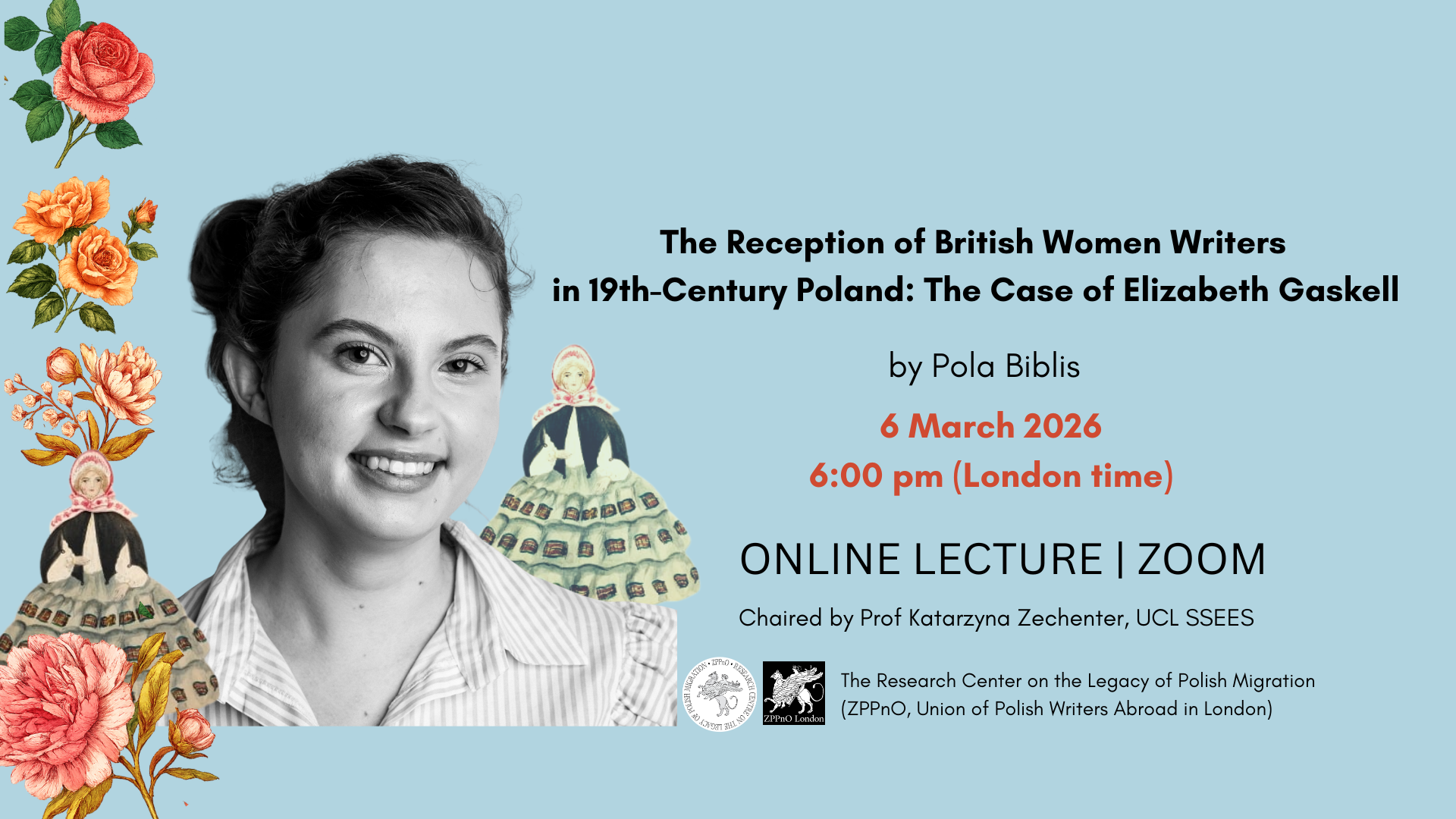
The lecture will focus on the reception of British women writers in 19th-century Poland, with particular attention to the work of Elizabeth Gaskell, one of the most important novelists of the Victorian era, best known for works such as Mary Barton, North and South, and Cranford. The event will explore the place of British literature within the Polish cultural horizon of the 19th century, as well as the role of women’s writing in the processes of literary reception and cultural transfer. The meeting is planned as a 60-minute session and will include the speaker’s presentation followed by a Q&A section. It will be chaired by Professor Katarzyna Zechenter of the UCL School of Slavonic and East European Studies, Vice Director of the Research Center on the Legacy of Polish Migration.
Pola Biblis is a PhD candidate in literary studies at the Jagiellonian University in Kraków. Her doctoral research examines encounters between “fallen” and “moral” women in 19th-century Polish and British literature, with particular attention to gender and class relations. Alongside her doctoral work, she is employed as a Commissioning Editor at the Znak Social Publishing Institute and occasionally leads creative writing workshops.
The event is intended for all those interested in 19th-century literature, women’s writing, comparative literary studies, and the reception of British authors in Poland.
Registration is required.
To register, please contact: obedep.london@gmail.com
Further details, including the Zoom link, will be shared upon registration.
Informacje
Zobacz także
The Bourgeois Public Discusses Art III: Transnational Media, Mediators and Art Practices in Central Europe
This workshop seeks to explore the intricate relationship between the bourgeois public (Reinhart Koselleck, Jürgen Habermas) and literature and the arts, with a particular focus on the transnational role of the media, mediators and art practices in Central Europe from the late 18th century until the end of the 19th century.
International Conference "Convention and Revolution. Life writing by women in the 1800s and 1900s: archives, critiques and methods"
Organizers: Institute of Literary Research of the Polish Academy of Sciences, Digital Humanities Laboratory of the University of Warsaw, Institute of Slavic Studies of the Polish Academy of Sciences
Literature in Exile Between ‘Authorship’ and ‘Translation’: The Central and Eastern European Experience
This conference aims to examine the complex relationship between ‘authorship’ and ‘translation’ in the work of the 20th-century Central and Eastern European writers in exile who were also translators. In the context of the reassessment of ‘literariness’ in the latter half of the 20th century, the conference is particularly focused on the overlapping relationship between both these concepts, which are seen as interrelated, historically variable categories of literary creativity of exiled writers in redefining themselves against the nationalist narratives. The workshop will thus contribute to the discussion on cultural translation and post-national literature in general.
Dorota Masłowska’s Provinces- A lecture by Prof. Katarzyna Czeczot
On May 26, Prof. Katarzyna Czeczot will argue that the language of Dorota Masłowska's Snow White and Russian Red (Wojna polsko-ruska pod flagą biało-czerwoną) has been shaped by the history of Poland as a Russian province in the 19th century and as a satellite country of the Soviet Union. The talk will explore the cultural game of inferiority and superiority, seen as inseparable from empire and province’s geography.